Mission Statement:"Pascendi Dominici Gregis!"(To feed the Lord's flock!)
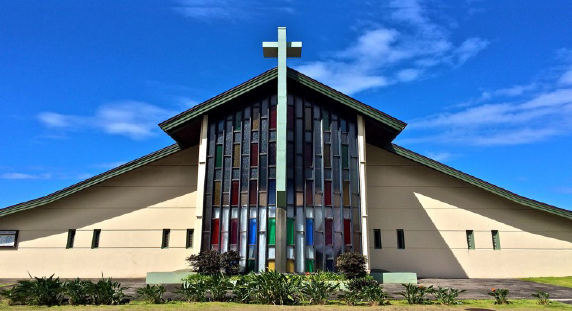
St. Pius X Catholic Church, Manoa
2821 Lowrey Avenue, Honolulu, Hi 96822 | Map Directions
Sacramental Emergency: (808) 773-7083
OFFICE: Phone (808) 988-3308 | Email: piusx@rcchawaii.org | Fax:(808) 773-7794
VISION: In the spirit of our Patron St. Pius-X, we, the Catholic community of St. Pius-X, Manoa aspire to live the happy and good witnessing of the Gospel through our Faith, Service, & Praise.
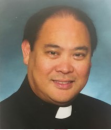
Rev. Nicholas Brown
Pastor
St. Pius X Parish is a diverse Catholic community of faith that embraces everyone, without exception. Challenged by the Gospel, nourished by the Eucharist, and inspired by the teachings of St. Pius X, we are called to be witnesses of Christ’s love for the Salvation of all people.
Parish Office
Monday - Friday
8:30 a.m. - 1:00 p.m.
Closed:
All State, Federal Holidays,
& Special Church Events
MASS SCHEDULE
WEEKDAY MASS
Monday - Thursday
Rosary - 7 a.m.
Mass - 7:30 a.m.
Friday - No Mass
WEEKEND MASSES
Saturday
7:30 a.m. |
4:00 p.m.
Sunday
8:30 a.m. | 11:30 am
VIEW LIVE STREAMED
Sunday 11:30 a.m.
Mass live streamed
CONFESSIONS
Weekdays
(By appointment only)
Saturdays
(Before Mass 3:00-3:30pm
before 4pm Mass
)
First Wednesday Devotion
7:30 a.m.
First Friday
7:30 a.m
Adoration and Benediction
First Friday 8:00 a.m
First Saturday Devotion
7:30 a.m
Saturday For the Virgin Mary
7:30 a.m

Food Pantry
Tuesday & Friday
10:00 a.m. - 11:30 a.m.

Celebrating Wedding Anniversary
Blessing of couples celebrating wedding anniversary in the church. Please contact parish office before the weekend celebration. Thank you.
Hospital Visits
& Home Communion
Please Contact the Rectory Office.
808 988-3308
Funerals Arrangements
Though not a Sacrament, when death occurs, contact the parish office immediately
808 988-3308
Saint Pius X Church- Manoa: NOW IN OUR PARISH
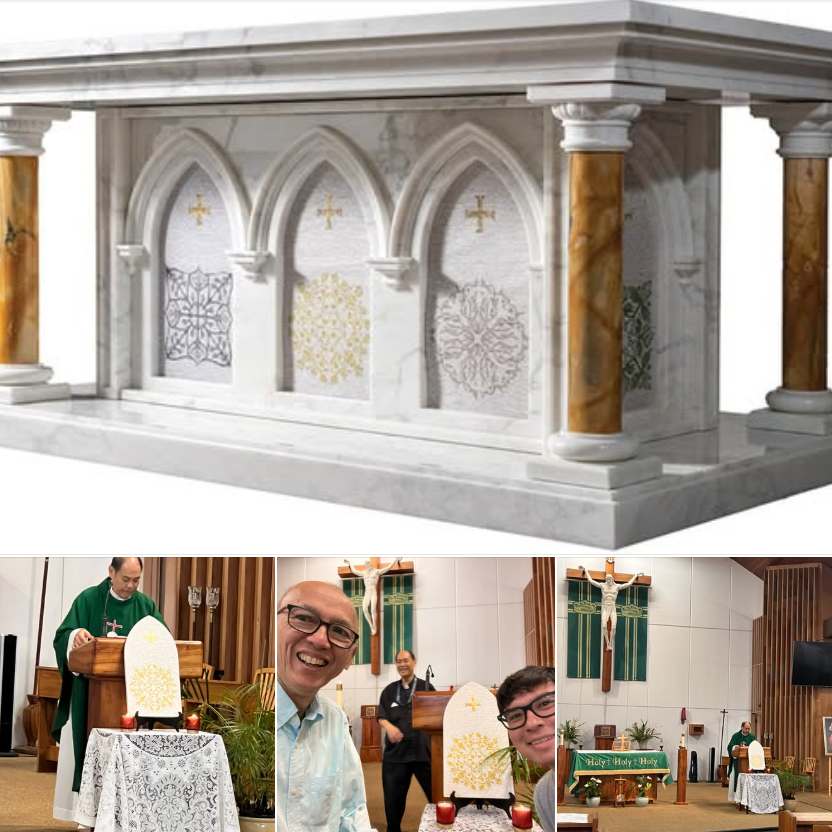
The fully assembled altar in the Rugo Stone studio in Virginia. (Courtesy Rugo Stone) Eight mosaic panels representing Hawaii’s major islands adorn the new altar for the Cathedral Basilica of Our Lady of Peace.
The altar’s top platform, called a mensa, consists of a single solid slab measuring approximately 5 feet by 7 feet and 5-6 inches thick.
The new altar is one of the many projects that will restore and renew the historic cathedral basilica, which was dedicated Aug. 15, 1843, on land provided by King Kamehameha III.
“The overall goal is to create a cohesive liturgical space that honors both historical traditions and local Hawaiian identity,” Shideler said.
Rugo Stone shipped each completed mosaic individually to Hawaii. The panels are now being taken to parishes on the islands they represent so parishioners can see them up close before they are installed in Honolulu.

On the occasion of the Year of Saint Francis, which runs until January 2027, the Apostolic Penitentiary grants a plenary indulgence under the usual conditions (sacramental confession, Eucharistic communion and prayer according to the intentions of the Holy Father), also applicable in the form of suffrage for the souls in Purgatory
1) to members: - of the Franciscan Families of the First, Second and Third Orders Regular and Secular; - of Institutes of Consecrated Life, Societies of Apostolic Life and public or private associations of the faithful, male and female, who observe the Rule of Saint Francis or are inspired by his spirituality or perpetuate his charism in any form;From a human point of view, this seems careless. An experienced farmer would avoid wasting seed on places where it could never grow. But that is precisely the point. God is not stingy with His grace. He is extravagant with His love.
2) to all the faithful without distinction who, with a heart detached from sin, participate in the Year of Saint Francis by visiting, in the form of a pilgrimage, any Franciscan conventual church or place of worship anywhere in the world dedicated to Saint Francis or connected to him for any reason, and there devoutly follow the Jubilee rites or spend at least a reasonable period of time in pious meditation and raise prayers to God so that, following the example of Saint Francis, feelings of Christian charity towards their neighbors and authentic vows of harmony and peace among peoples may spring forth in their hearts, concluding with the Our Father, the Creed and invocations to the Blessed Virgin Mary, Saint Francis of Assisi, Saint Clare and all the Saints of the Franciscan Family.
The elderly, the sick and those who take care of them, and all those who are unable to leave their homes for serious reasons may also obtain a Plenary Indulgence, provided they detach themselves from any sin and intend to fulfil the three usual conditions as soon as possible, if they unite themselves spiritually to the jubilee celebrations of the Year of Saint Francis, offering to the Merciful God their prayers, the pains or sufferings of their lives.
The designated pilgrimage sites by Bishop Larry Silva in the Diocese of Honolulu are: Co-Cathedral of St. Theresa (Honolulu), St. Francis Church (Kalaupapa), Holy Trinity Church (Kuliouou), St. Rita Church (Nanakuli), Immaculate Conception Church (Lihue), Christ the King Church (Kahului), St. Damien Church (Kaunakakai), Sacred Hearts (Lanai), St. Michael the Archangel Church (Kailua-Kona), and St. Joseph Church (Hilo).

St John Paul II
October 22
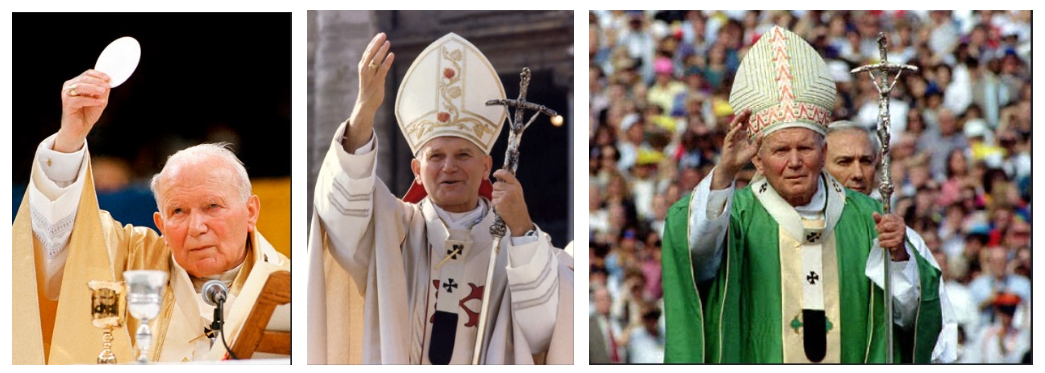
St John Paul II was the Pope and head of the Catholic Church from October 16 1978 until April 2 2005. He was born in Wadowice, Poland as Karol Józef Wojtyła on May 18 1920 and died on April 2 2005 at the age of 84 in his Apostolic Palace, Vatican City. We celebrate his feast day on October 22 every year in the Catholic Church.
Saint John Paul II ✝️ (Karol Józef Wojtyła)
Feast Day: October 22
Patron of: World Youth Day, families, and the new evangelization
Who Was St. John Paul II?
Pope St. John Paul II (1920–2005) was one of the most beloved popes in modern history — a man of deep faith, courage, and vision. He served as Pope from 1978 to 2005, making him one of the longest-reigning popes ever. He was known as“The Pilgrim Pope” for visiting more than 120 countries, spreading a message of peace, dignity, and the love of Christ to the whole world.
Early Life
1920, in Wadowice, Poland. - His mother died when he was 8; his father and brother also passed away before he turned 21. - Despite great sorrow, Karol developed a profound love for prayer, the Blessed Virgin Mary, and the Eucharist. He studied secretly for the priesthood during Nazi occupation, risking his life for his faith.
Priest and Bishop
- Ordained a priest in 1946.
- Became Bishop of Kraków in 1958, and Cardinal in 1967.
- He was an active voice in the Second Vatican Council, shaping Church teaching on human dignity, religious freedom, and the role of the laity.Despite great sorrow, Karol developed a profound love for prayer, the Blessed Virgin Mary, and the Eucharist.
Elected Pope
-Elected Pope on October 16, 1978, taking the name John Paul II.
-The first non-Italian pope in 455 years, and the first Slavic pope in history.
- His motto: “Totus Tuus” (“Totally Yours”) — expressing his total consecration to the Blessed Virgin Mary.
Key Contributions
1.Defender of Life and Human Dignity
He taught that every human being — from conception to natural death — has infinite value because we are all made in the image of God.
2. Theology of the BodyA revolutionary teaching on the beauty of human love, marriage, and sexuality as reflections of God’s divine love.
3. Champion of YouthHe founded World Youth Day, gathering millions of young people to deepen their faith and commitment to Christ.
4. Bridge BuilderHe reached out to all religions, meeting with Jews, Muslims, and people of other faiths to promote peace and understanding.
5. Communism and Freedom His courage and leadership helped inspire the fall of Communism in Eastern Europe, especially in his homeland, Poland.
6. Devotion to MaryJohn Paul II had deep Marian devotion, especially to Our Lady of Fatima, who he believed saved his life during the 1981 assassination attempt.
The bullet that struck him was later placed in the crown of Our Lady of Fatima’s statue in Portugal.
Death and Canonization
- Died on April 2, 2005, the eve of Divine Mercy Sunday.
- Beatified in 2011 and canonized by Pope Francis on April 27, 2014, together with Pope John XXIII.
-His motto: “Totus Tuus” (“Totally Yours”) — expressing his total consecration to the Blessed Virgin Mary.
- His feast day, October 22, marks the anniversary of his papal inauguration.
Famous Quotes by St. John Paul II
“Do not be afraid. Open wide the doors to Christ.”
“The future starts today, not tomorrow.”
“It is Jesus that you seek when you dream of happiness.”
“Freedom consists not in doing what we like, but in having the right to do what we ought.”
“Love is never defeated, and I could add, the history of Ireland proves it.”
“Be not afraid to be saints of the new millennium.”
Pope John Paul II is the Patron Saint of
- Young Catholics
- Beatified in 2011 and canonized by Pope Francis on April 27, 2014, together with Pope John XXIII.
- World Youth Day (co-Patron)
- World Meeting of Families 2015 (co-patron)
- Families

Saints Simon and Jude -28th October
Jude is so named by Luke and Acts. Matthew and Mark call him Thaddeus. He is not mentioned elsewhere in the Gospels, except of course where all the apostles are mentioned. Scholars hold that he is not the author of the Letter of Jude. Actually, Jude had the same name as Judas Iscariot. Evidently because of the disgrace of that name, it was shortened to “Jude” in English. Simon is mentioned on all four lists of the apostles. On two of them he is called “the Zealot.” The Zealots were a Jewish sect that represented an extreme of Jewish nationalism. For them, the messianic promise of the Old Testament meant that the Jews were to be a free and independent nation. God alone was their king, and any payment of taxes to the Romans—the very domination of the Romans—was a blasphemy against God. No doubt some of the Zealots were the spiritual heirs of the Maccabees, carrying on their ideals of religion and independence. But many were the counterparts of modern terrorists. They raided and killed, attacking both foreigners and “collaborating” Jews. They were chiefly responsible for the rebellion against Rome which ended in the destruction of Jerusalem in A.D. 70.
Scriptural Mentions
- Luke 6:15–16: “Simon who was called the Zealot, and Judas son of James.”
- John 14:22: St. Jude (Thaddeus) asks Jesus, “Lord, why do you intend to show yourself to us and not to the world?” — showing his sincere faith and desire to understand Christ’s mission.
Patronages
- St. Simon: Tanners, sawmen, curriers (leather workers).
- St. Jude: Hopeless causes, desperate situations, hospitals, and lost causes.
Prayer to St. Jude and St. Simon
O God, who through your blessed Apostles Simon and Jude have brought us to know your Name, grant that through their intercession the Church may constantly grow by the increase of the peoples who believe in you. Through Christ our Lord. Amen.